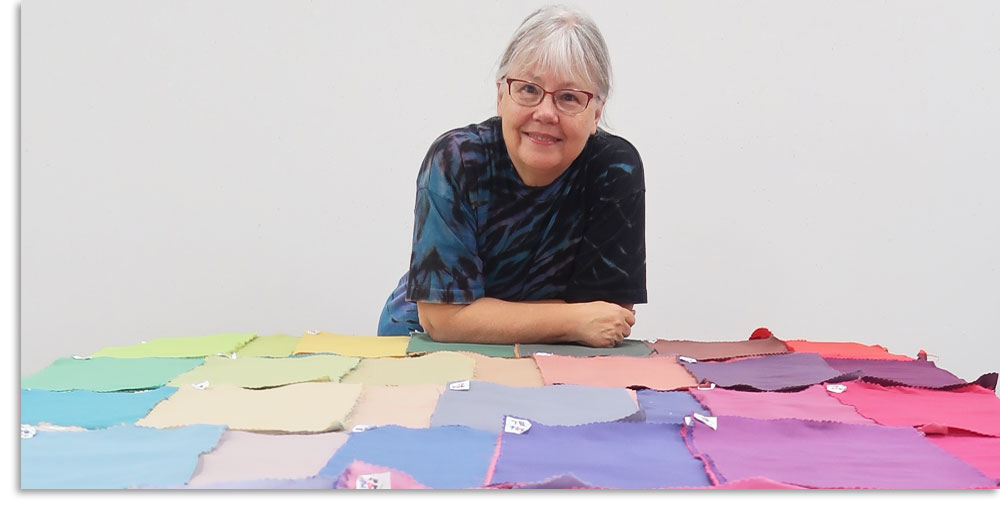
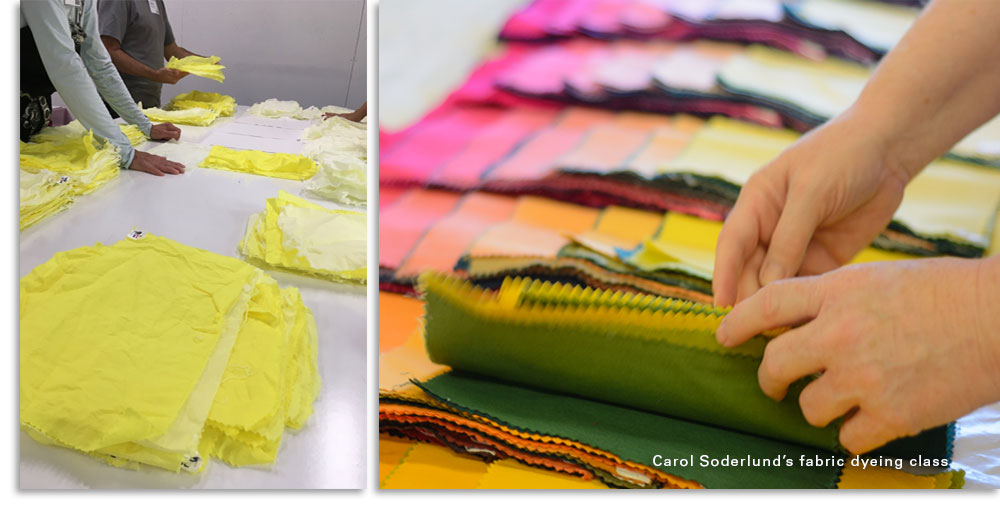
Carol began dyeing fabric in 1988 when she couldn't find the colors she needed to bring the "vision" of a quilt to life. With her hand-dyed fabric she was able to create the quilt, which subsequently won Best of Show at the 1989 International Quilt Festival in Houston, Texas. Since then, dyeing and surface design processes have become an enduring interest for her. As a quilt artist, Carol is known for her use of color to create transparent, luminous, and dimensional effects of great subtlety. Her work incorporates hand-dyed, stamped, stenciled, and discharged fabric in combination with commercial fabrics and many decorative threads. She continues to make quilts, and exhibits them nationally and internationally. Carol is in demand as a teacher of color, fabric dyeing, and machine quilting techniques. She lives in Geneva, New York with her husband, two sons, three boats, and a fabric stash.
Carol's web site: www.carolsoderlund.com
• Dates: April 6-10, 2009
• Level: Beginning to Advanced | Some previous dye experience is helpful but not required
• Zig Zag Sewing Machine: No
• Tuition | Early (paid in full by November 1, 2008): $750
• Tuition | Regular (paid in full by February 1, 2009): $770
• Materials Fee: will be uploaded soon
• Dye Facility Usage Fee: $25
> Accommodations and meal information
![]() |
|
![]() |
DESCRIPTION
Silk, that lovely seductive cloth which intrigues us with its luster and sensuous drape, is also very versatile in its ability to accept both fiber reactive and acid dyes. As students explore color on silk in this very focused class, they will create a sample book of swatches using fiber reactive dyes. In addition, students will sample multiple possibilities/solutions as they compare cold batch methods and steaming methods, as well as alkaline-based and acid-based reactions. Using a variety of application processes, including low water immersion, pole-wrapped and clamped shibori, and printmaking processes, students will create effects on a wide variety of silks such as raw silk, crepe, rayon/silk velvet, organza, chiffon, and more.
THINK SILK! COME AND CREATE A SILK BONANZA!!!
This class is suitable for all levels of experience, both for those who have had Carol’s class Color Mixing for Dyers, and for those who have not.
SUPPLY LIST will be uploaded soon!
![]() |
|
• Dates: April 13-17, 2009
• Level: Beginning to Advanced | Some previous dye experience is helpful but not required
• Zig Zag Sewing Machine: No
• Tuition | Early (paid in full by November 1, 2008): $750
• Tuition | Regular (paid in full by Feb. 1, 2009): $770
• Materials Fee: $65
• Dye Facility Usage Fee: $25
> Accommodations and meal information
DESCRIPTION
Dye the color you choose, not the color that chooses you!
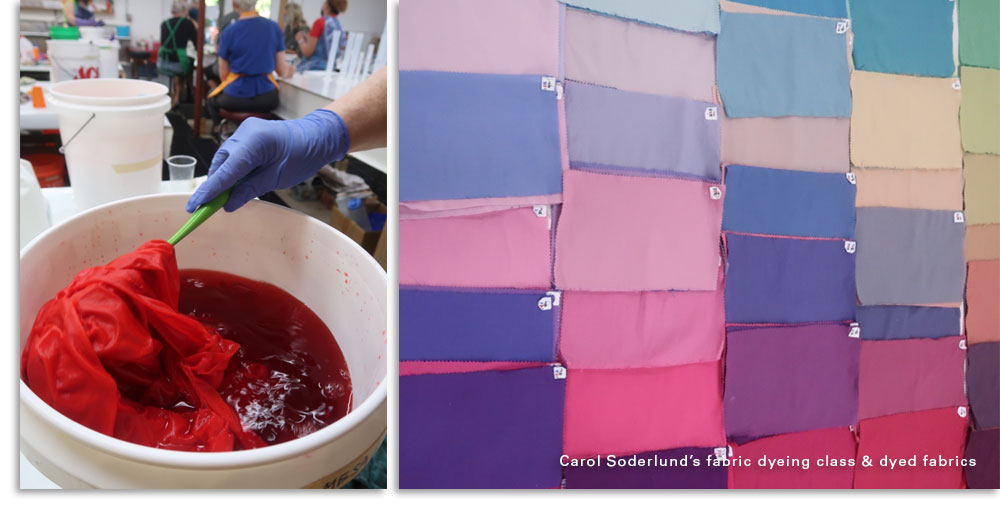
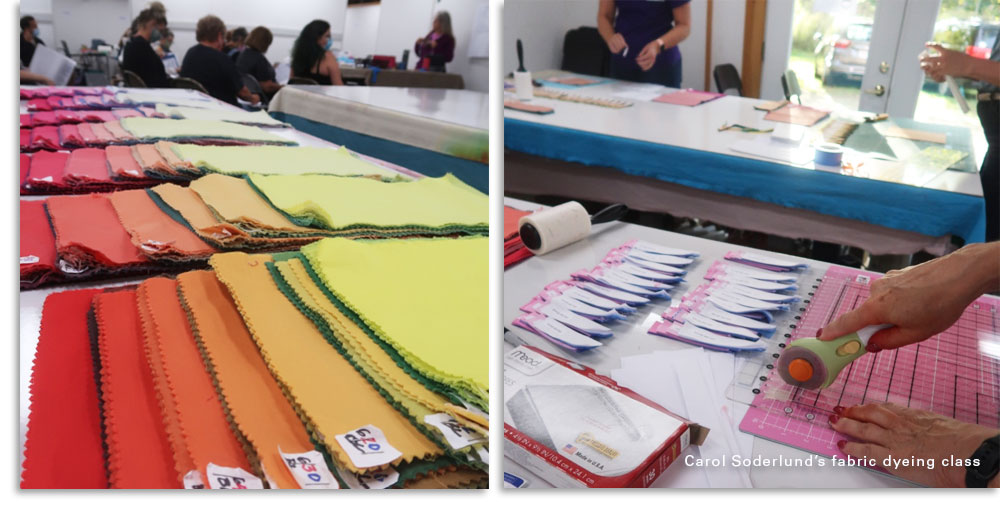
In the manufacture of Procion MX dyes there are 22 colors which are “pure” hues, dye powders which are unmixed as they come from the manufacturer. These include several primary colors – yellows, reds, and blues – each with its own properties of hue and interaction with the cloth. In this class we will explore these primaries and the colors obtained by mixing them. Teams of students will use different sets of primaries that when mixed will yield hundreds of colors in a wide range of values. Sharing the results, each student will build a sample book of more than 1000 dye formulas on 100% cotton fabric. This book will become an invaluable reference for future dyeing. This systematic approach will lead to a practical understanding of color theory, including how to mix neutral tans, grays, and blacks and their relationship to purer more intense hues. Using the sample book as a guide, each student will apply the basic techniques of dyeing, including over-dyeing, dyeing value gradations, gradations between colors, low water immersion, etc. to do further explorations as time allows.
• Please note: this class is also perfect for people who dye yarn...knitters, weavers!
![]() |
|
Supply List (Please label your own supplies)
• 3 ring binder, 3” thick
• 100 CLEAR top-loading page protectors (buy in bulk at office supply store)
• 1 package Avery self-adhesive index tabs with colored tabs, 25 in package
• 4 rolls (25 yards each) Scotch Double Coated Tape, 1/2” wide with 1” core in yellow box such as
Staples item# 130500 @ $4.29 or
Office Max # 09001741 @ $3.49 or
Office Depot # 172635 @ $3.46
• 1 desktop tape dispenser with 1” core (available at Staples for around $2) This makes life MUCH easier!
• 21 business-size (long white) envelopes
• stapler plus extra staples, and staple remover if you have one
• 20 rubber bands
• Sharpie (permanent marker)
• highlighter
• small pair scissors for paper and one for fabric
• rotary cutter—60 mm size with a fresh straight blade is recommended as you will be cutting through numerous layers at once
• mat—11” x 17” if you are flying, or larger if you are driving
• plexiglas ruler (12” long)
• Iron and ironing pad
• rubber gloves, both the loose dishwashing kind that extend up the wrist, and the close-fitting latex kind
• 1 roll paper towels
• (if you are driving) two 5 gallon buckets
• 10 plastic cups, 16 oz size, and 10 plastic picnic spoons
• one 2-liter soda pop bottle, one 1 liter soda pop bottle, and one gallon milk jug, all rinsed
• 1 large strong plastic spoon, at least 12” long. Straight with no bends or angles is preferable.
• 5 yards fabric for further dye explorations (PFD--prepared for dyeing-- fabric recommended.)
• plastic bags to carry wet fabric: one box one gallon Ziploc bags, 6 kitchen garbage bags
• calculator
Optional: samples of your dyed fabric and/or photos of your work
The materials fee provides:
All the dyes and necessary chemicals, handouts, and all the fabric necessary for the sample book. Carol will bring a variety of other equipment to use in class. A limited amount of extra PFD fabric will be available for purchase in class.

> Click here to see an image gallery of the Crow Timber Frame Barn
