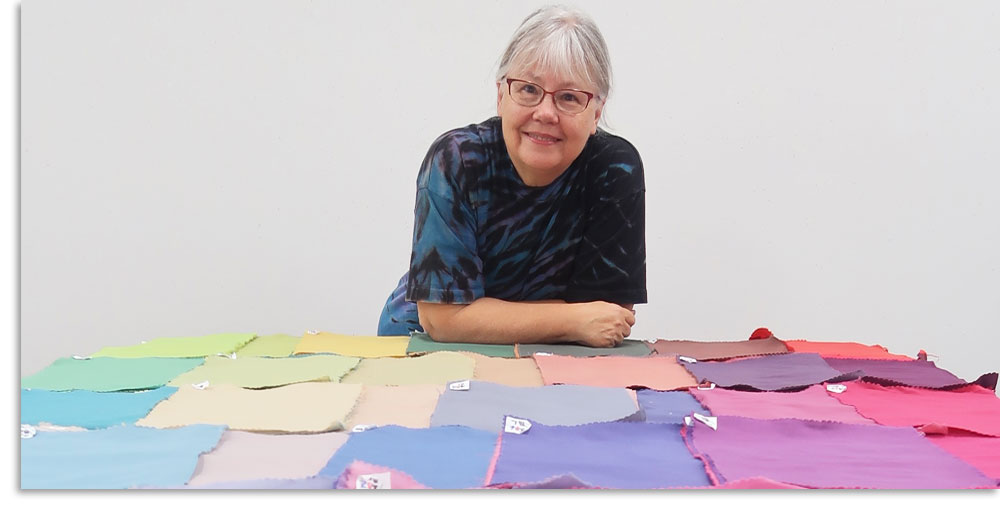
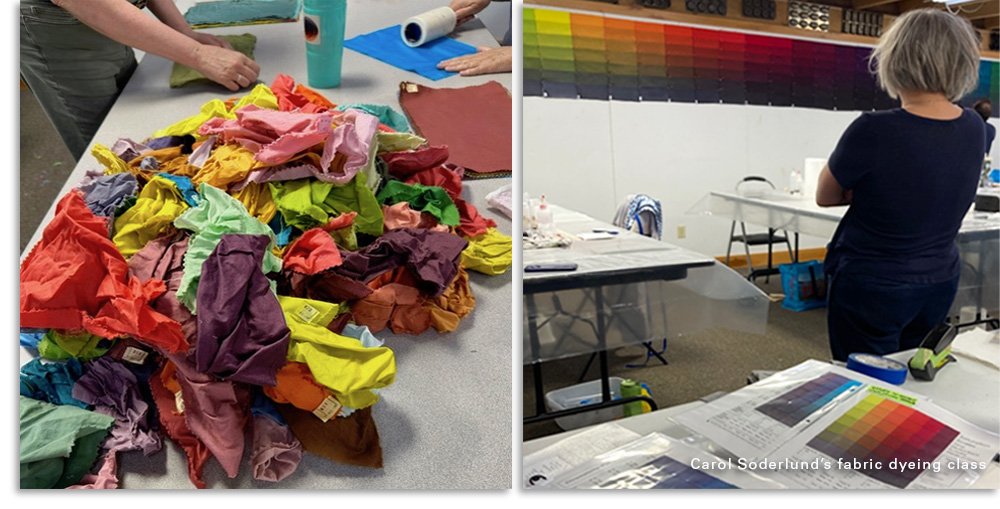
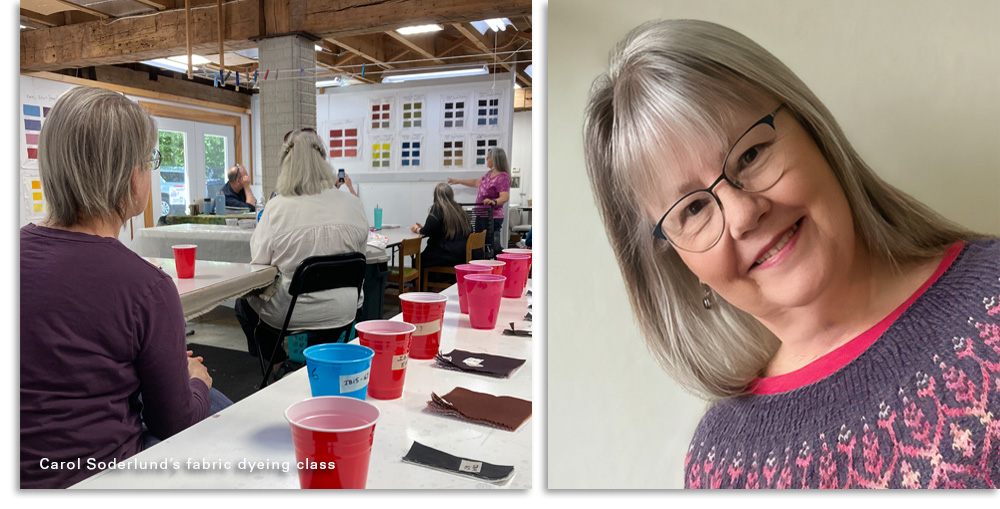
Carol Soderlund fabric dyeing workshops

Carol Soderlund

An artist and educator for 25+ years, Carol’s curiosity about the range of color derived from blending yellow, red, and blue dyes led to the creation of her Color Mixing system for dyers. Carol encourages the freedom of mixing color by eye with results-based samples to guide the student, and also teaches simple methods for reproducing color on cloth. 

A former high school teacher, Carol loves to develop original course material and share this knowledge with her students. Carol was nominated for Teacher of the Year in 2013 and again in 2015 by the International Association of Creative Arts Professionals.  

Carol is co-author of
Playful Fabric Printing with Melanie Testa. She has shown her quilts in juried venues across the country, winning awards including Best of Show at the International Quilt Festival in Houston, Texas.

Carol’s web site
  • • May 16-21 & May 23-28, 2027 | Color Mixing for Dyers: The Deep Dive

    Open or Close
    Color Mixing for Dyers: The Deep Dive
    • Level: Intermediate to Advanced. Experience with Procion MX dye required.
    • Sewing machine:
    No
    • Materials fee:
    $120
    • Dye facility usage fee: $60

    Tuition & Meal plan for 2-week class with Carol:
    • $3200 | paid in full before December 1, 2026 | 10-day Tuition ($2500) & Meal plan ($700)
    • $3250 | paid in full before February 1, 2027 | 10-day Tuition ($2550) & Meal plan ($700)
    Stacks Image 30024
    DESCRIPTION
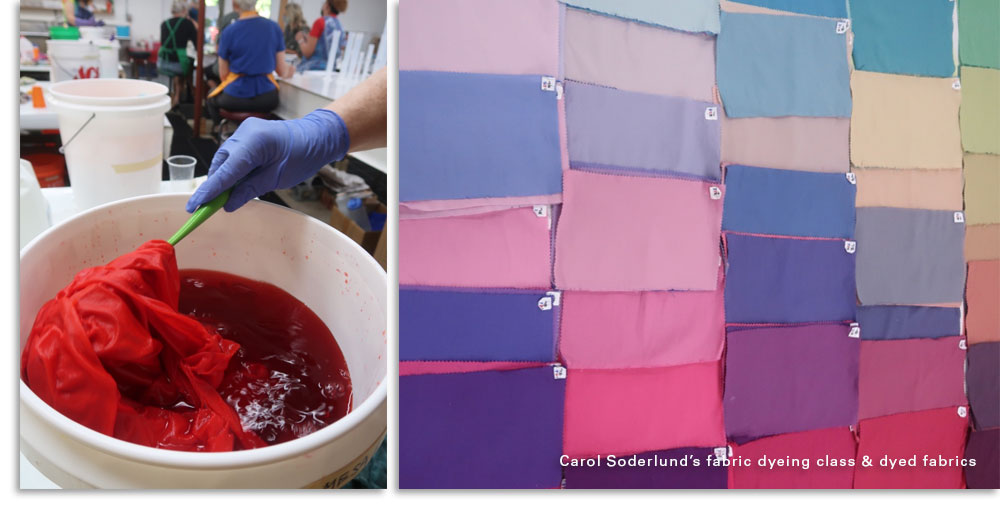
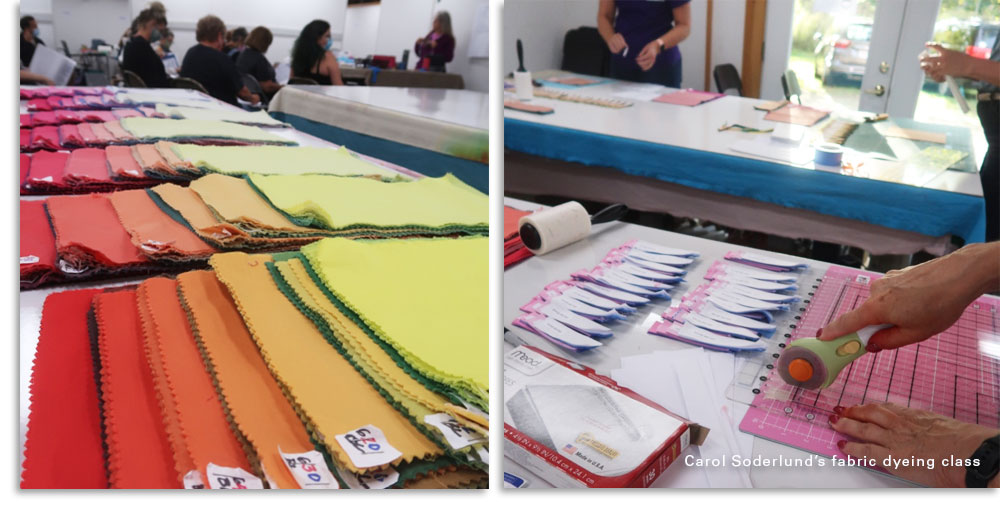
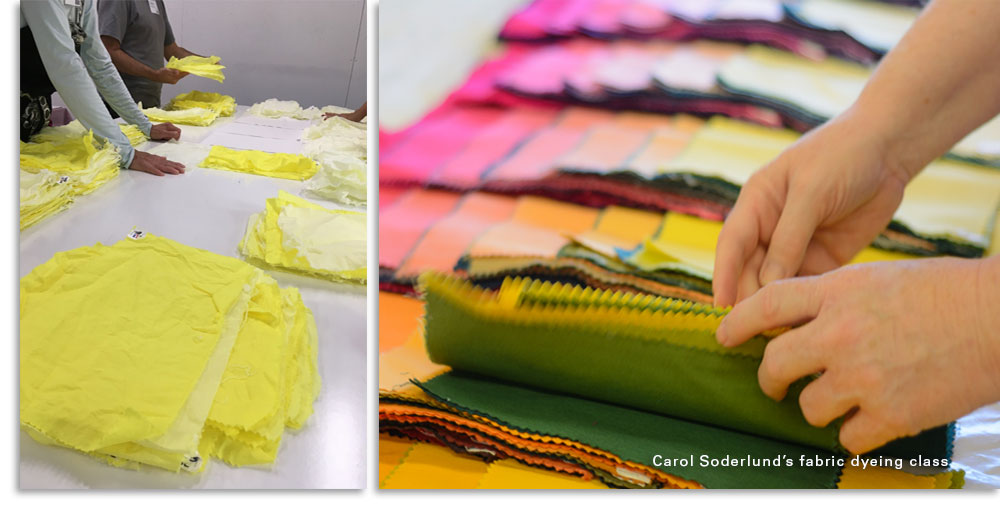
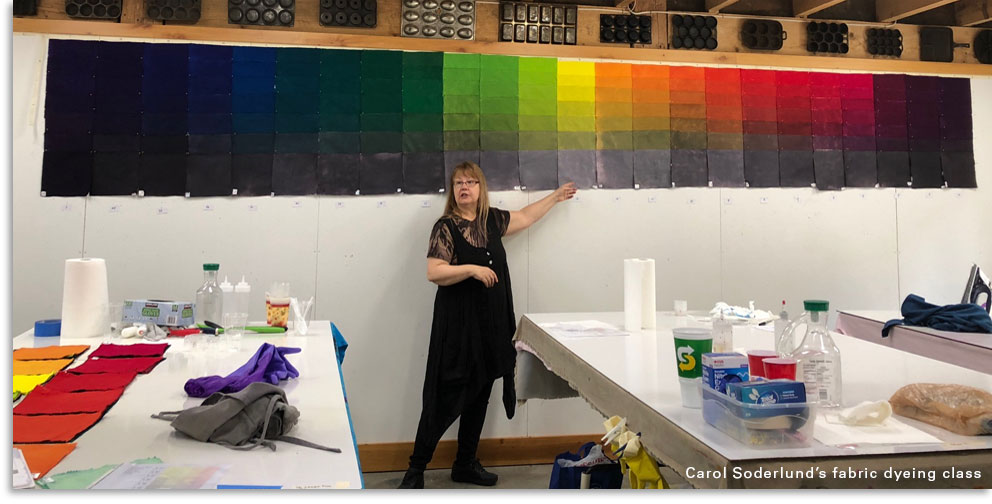
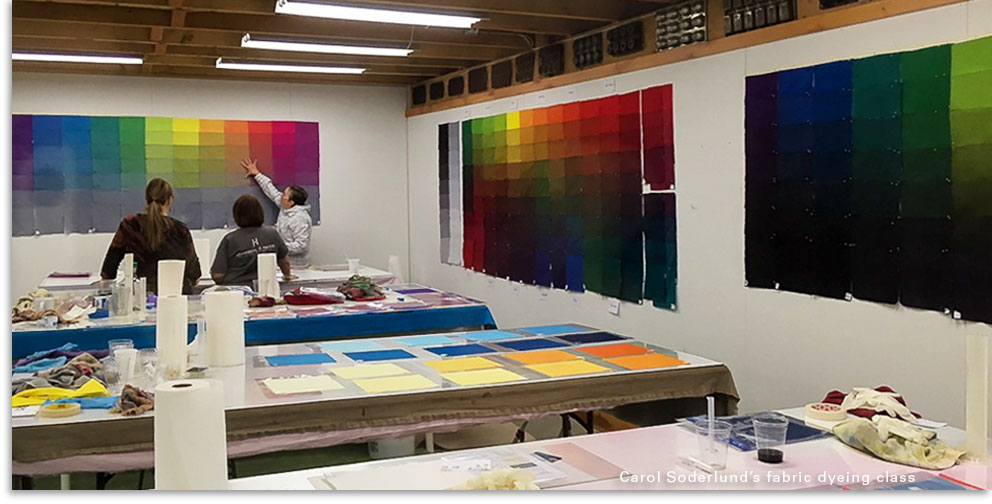
    Dye the color you choose, not the color that chooses you! Explore the unlimited number of hues possible by mixing only pure reds, yellows, and blues of Procion MX fiber reactive dye. Teams of students will use different sets of primaries that when mixed will yield hundreds of colors in a wide range of values. Sharing the results, each student will build a sample book of more than 1,000 dye swatches and their recipes on 100% cotton fabric.

    But this is just the start!
    Yes, we will still be dyeing new color families, but we will have time to expand the concepts with new projects and challenges.

    This course is the next step for dyers who have worked with Procion MX fiber reactive dyes and want to go further into what color can actually do. It builds on the foundation of Color Mixing For Dyers and takes the three-dimensional color cube model further than a one-week format allows.

    For more than twenty years I have been teaching dyers to mix color from pure primaries and build a sample book of over a thousand swatches and recipes. That sample book is more than a reference. It is an education in itself, and every time I finish a course, I can see that there is more to explore than we had time for. This course is my answer to that.

    The sample book is a learning tool, not just a reference. In this two week version, practice precedes theory. Using color principles as taught by Josef Albers as a guide, students will observe color behavior as well as dye behavior. The concepts introduced will name and explain what they are already seeing emerge from the dye pot.

    Albers’ central insight is one that many artist’s know in their gut – that color is relative, that every color you dye will look different depending on the values, temperatures, and hues surrounding it. Understanding why, and being able to work with that knowledge intentionally, is what this course is about.

    The course runs two parallel tracks throughout the ten days. In the first, teams of students use different sets of primaries to mix and dye new color families, building a shared sample book of more than a thousand swatches on 100% cotton. Because each team works with a different set of primaries, the group ends up covering far more color territory than any one person could cover alone. You share all of it, and you leave with a reference that reflects that collective work.

    In the second track, you work through a series of focused color projects with defined objectives. Advanced students may propose independent study projects as well.

    Slide presentations introduce one color concept each day, and the studio session is structured so that you will encounter that concept directly in your own work before the day is out. Note-taking and studio documentation are built into the daily rhythm. A practice that includes careful observation and recording produces results you can understand and repeat, not just admire.

    You will leave with a complete sample book, a studio journal, and the hand-dyed yardage and documentation from focused projects. More than that, you will leave with a more educated eye for the way colors behave together, and a framework you can take back into your own studio.
    Stacks Image 30026
    Stacks Image 30030
    SUPPLIES
    (Please label your own supplies)

    Fabric & color inspiration:
    • 10-15 yards fabric for further dye explorations (PFD - prepared for dyeing - fabric recommended. In addition to cotton, you may bring some silk, rayon, linen or tencel if you like to work in these fibers. Note to weavers: It is fine if you would like to bring some skeined yarns for dyeing: cotton, linen, rayon, tencel, or silk.
    • Color inspiration images: This can be a physical collection and also digital photographs – but have at least 2-3 favorites printed in color - 8”x10”
    • Optional: iPad with the Procreate app

    Office supplies:
    • Notebook for note taking and a pen
    • Studio journal - more info coming later
    • 2 three-ring binders,
    one 1/2” thick, and one 1 1/2” thick
    • Large post-it notes
    • 100 CLEAR page protectors (Buy in bulk at office supply store: do not buy those that have holes through the main section of the page protector. You want the ones with holes through the band on the margin.)
    • Scotch double sided tape - 1/2” wide (enough to total 120 yards of tape)
    • Masking tape
    • 30 long (#10) envelopes
    • Stapler plus extra staples
    • 20 rubber bands
    • Sharpie (permanent marker) - both Ultra Fine Point and Fine Point suggested
    • Calculator

    Cutting tools:
    • Small pair scissors for paper and one for fabric
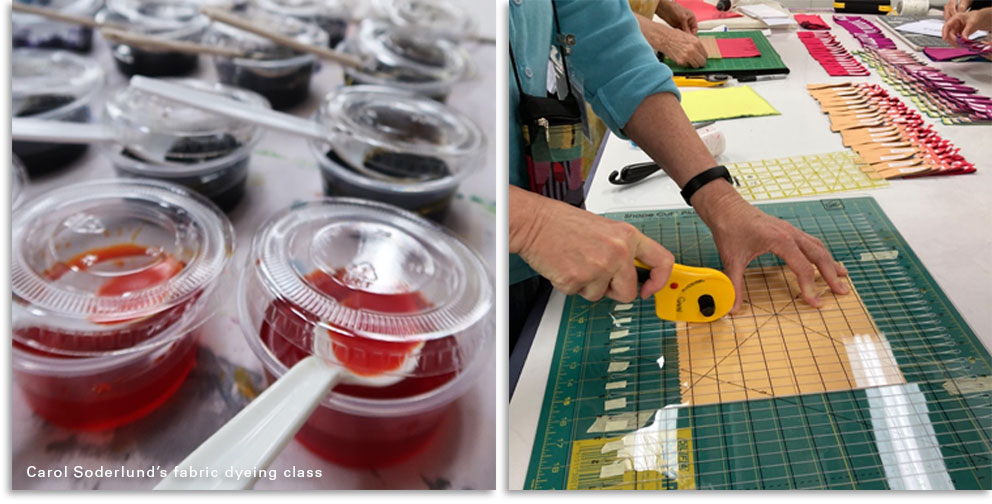
    • Rotary cutter (Bring a fresh straight blade as you will cut through numerous layers at once. The large (60mm) cutters work the best for this. Students tell me that if you bring a 45 mm cutter you will struggle, as the depth of fabric is deeper than the exposed blade.)
    • Rotary cutting mat (11” x 17” or larger if you can manage it)
    • Quilter’s plexiglas rulers (6” x 12” and 6” x 24”)

    Other items:
    • Small plastic spoons
    • Three 6 or 8 oz. pointy top bottles
    • Flat piece of plexiglass - 1/8” thick by 11”x14” or 12”x12” (available at home centers
    or local glass shops). Exact size not critical, as long as all sides are at least 11 inches.
    • 3 lingerie bags, 16”x20” with zippers - These will be used in the washout process
    • Straight pins for use on design walls
    • Iron and ironing pad, or old terry towel (if you are driving)
    • Adhesive lint roller from the dollar store
    • Rubber gloves - both the loose dishwashing kind that extend up the arm, and the close-fitting latex or nitrile kind
    • No need to bring 5 gallon buckets since the Barn has them!
    • 1 large strong plastic spoon at least 12” long - straight, not bent, is better
    • 1 box of one gallon Ziploc bags
    • Dye mask
    • Apron or old clothes
    • Graduated cylinders - if you have some from previous classes, bring your 50ml, 100ml and 250ml cylinders. Carol will bring extra cylinders to share.

    Plastic containers: (If you are flying, we will arrange to get these items for you as
    needed.)
    • 1 plastic orange juice bottle - Simply Orange brand (or limeade, etc.)
    • 1 gallon milk jug - Rinse all jugs, and be sure to keep the caps!

    Materials fee info:
    Carol will provide all the dyes and chemicals necessary, as well as over 100 pages of handouts and swatch book pages, and all the fabric necessary for the sample book. Carol will bring a variety of other equipment to use in class.

    If you have any questions about the materials list or the course in general, please
    contact Carol

  • • 2027 Spring Art Retreats | Tuition and Meal Plan
    Tuition & Meal plan for 2-week class with Carol Soderlund:
    Both weeks (10-day class) of these workshops are to be taken back-to-back. No registrations accepted for only one week.
    • $3200 | paid in full before December 1, 2026 | 10-day Tuition ($2500) & Meal plan ($700)
    • $3250 | paid in full before February 1, 2027 | 10-day Tuition ($2550) & Meal plan ($700)
    + $180 materials & dye facility usage fee

    Tuition & Meal plan for 2-week class with Rodger Blum:

    Both weeks (10-day class) of this workshop are to be taken back-to-back. No registrations accepted for only one week.
    Class size limited to 16 students.
    • $3700 | paid in full before December 1, 2026 | 10-day Tuition ($3000) & Meal plan ($700)
    • $3750 | paid in full before February 1, 2027 | 10-day Tuition ($3050) & Meal plan ($700)
    + $150 materials & facility usage fee

    Tuition & Meal plan for 2-week classes with Nancy Crow:
    Both weeks (10-day class) of these workshops are to be taken back-to-back. No registrations accepted for only one week.
    • $3200 | paid in full before December 1, 2026 | 10-day Tuition ($2500) & Meal plan ($700)
    • $3250 | paid in full before February 1, 2027 | 10-day Tuition ($2550) & Meal plan ($700)


    Meal plan
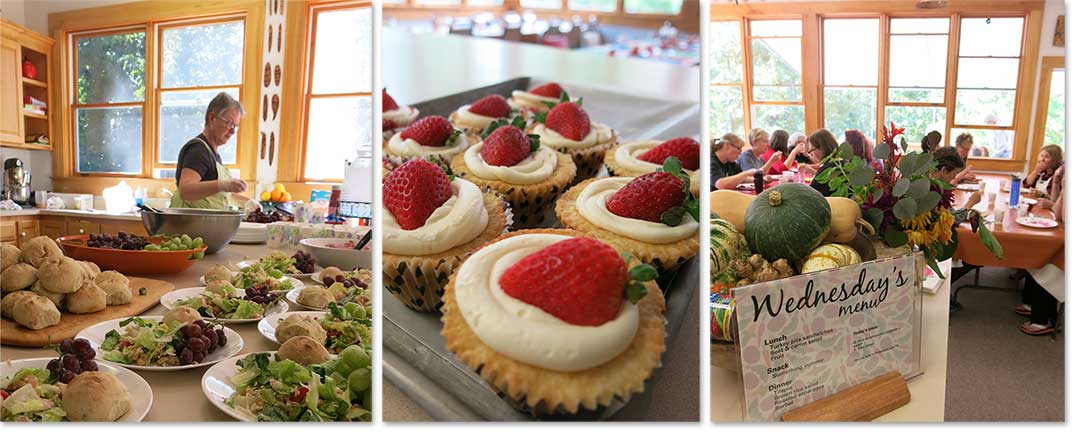
    During the art retreats, Margaret Wolf, will prepare fabulous gourmet lunches and dinners plus a coffee/snack break daily during each week of class. The meal plan is provided so participants may concentrate fully on their work without being bothered by the interruption and inconvenience of cooking for themselves. The break times present a great opportunity to get to know your fellow students, share ideas, and just relax together in this wonderful environment.

    The meal plan includes an opening night welcome dinner, five lunches, five afternoon coffee/pastry breaks, and four more dinners during the duration of the workshop. Coffee, tea and water will be served during these break times. Participants are responsible for any other beverage choices, such as soda pop, beer, wine, milk or bottled water.

    Please keep in mind that if anyone chooses not to participate in the meal plan, they are solely responsible for all of their meals, snacks, coffee, tea, and other beverages. The kitchen facilities are reserved for the resident chef. There is a microwave and a refrigerator in the wet studio for student use. Most restaurants are at least a 20 minute drive away from the barn.

    Please note: Due to facility limitations, meal plans are available only for workshop participants.
  • • Accommodations
    Accommodations:

    New hotel Hampton Inn, Canal Winchester, Ohio (20-25 minute drive to Crow Timber Frame Barn)
    This new, highly rated, clean, comfortable hotel is offering reduced rates. Phone: 614-953-2204
    • For special rate, please book online

    The Morgan Theater Home, Baltimore, Ohio (5 minute drive to the Crow Timber Frame Barn, mention Crow Barn)
    Former silent movie theater converted into a private residence. Three rooms for rent include free cable TV & free high speed internet access. Kitchen/refrigerator/stove & all "kitchen stuff" available. Phone: 740-862-4765 or Email

    Other accommodations, please negotiate your own weekly rates:

    AirBnB options in the area near the Crow Timber Frame Barn

    City of Lancaster, Ohio (20-25 minute drive to the Crow Timber Frame Barn)
    • Holiday Inn Express & Suites, 740-654-4445
    • Hampton Inn, 740-654-2999
    City of Reynoldsburg, Ohio (20-25 minute drive to the Crow Timber Frame Barn)
    • Fairfield Inn, 614-864-4555

    Campgrounds near the Crow Timber Frame Barn
    Rippling Stream Campground, Baltimore, OH, 740-862-6065, (5 minute drive to the Crow Timber Frame Barn)
    KOA Campground, Buckeye Lake, OH, 740-928-0706, (15-20 minute drive to the Crow Timber Frame Barn)
  • • Miscellaneous information
    Roommate
    • Please let us know if you would like a roommate. We will try to match you with another participant to share accommodations.

    Travel to and from the Crow Timber Frame Barn
    • The Barn is located near Baltimore, Ohio (southeast of Columbus, Ohio)
    • Please keep in mind that there is not a shuttle service to and from the motels to the farm, therefore please arrange a rental car or carpool with another participant.
    John Glenn Columbus International Airport (CMH) in Columbus, Ohio, is the major airport serving the area (30 minute drive to the Barn)

    Rental sewing machines, cutting mats & lamps
    • Bernina sewing machines are available for $75 per 5-day class or $150 per 10-day class.
    • Cutting mats are available for $15 per 5-day class or $30 per 10-day class.
    • Lamps are available for $15 per 5-day class or $30 per 10-day class.

    Formal class hours
    • Monday-Friday: 9-12 and 2-5 daily
    (Classrooms are open 7 am-9 pm Monday-Thursday, 7 am-5 pm Friday)

    Professional facilities
    Each student is provided with a large work table, an 8’ x 8’ work wall, and a comfortable chair. Classrooms are well illuminated and are open from early morning until late in the evening, plus the classrooms have air conditioning & heating. The surface design/dye studio at the Crow Timber Frame Barn includes large padded tables, lots of light (natural and color-corrected bulbs), 3 commercial stainless steel sinks, & washer/dryer. All facilities are non-smoking.

    Mailing list
    If you would like to be placed on a mailing list for information about upcoming art retreats, please send your contact info.

    Questions? Email
Images of Carol Soderlund, student work and classes at the Crow Timber Frame Barn