
D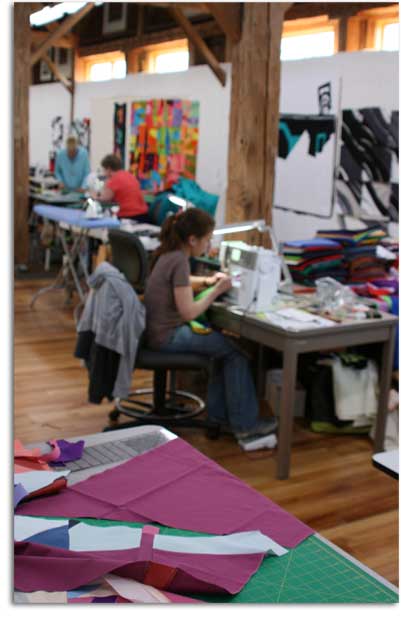 iscover this beautiful jewel in the farmland of central Ohio where one can attend quiet, secluded art retreats. Twice a year, the Crow Timber Frame Barn opens for individuals and small groups wanting private art and textile workshops. The retreats take place in the most beautiful months of the year, a time when there are spectacular floral displays and comfortable temperatures; these are the months of April/May and again in the fall months of September/October.
If your dream has been to study with leaders in the fields of contemporary quilt making, fabric dyeing, composition, color, design, machine-piecing, machine-quilting, fabric and paper collage, shibori, screenprinting, mark-making and surface design on fabric, in superbly outfitted classrooms dedicated to serious art making, then this is the location. (Class levels range from beginning to advanced.) While at the farm, one can absorb the beauty of the surrounding landscape, 90 acres of trees, fields, pond, and walkways, focused on conservation practices that have elevated the numbers of song birds, assorted creatures and native plants. Embrace this opportunity to savor the quietness of the farm, broken only by nature's songs, while learning about composition, color, collage, drawing, printing, sewing techniques, quilting and dyeing.
Enjoy the camaraderie of others from all over the world who share similar interests and make lasting friendships. Students have traveled to the Crow Timber Frame Barn for workshops from Australia, Canada, China, Germany, Israel, Japan, Mexico, New Zealand, Scotland, Spain, Switzerland, U.K., Vietnam, and nearly every state in the U.S.
> Testimonials about the Crow Timber Frame Barn Art Retreats
Professional Facilities
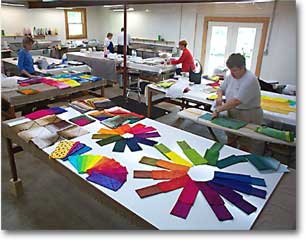
Each student is provided with a large work table, an 8’ x 8’ work wall, and a comfortable chair. Classrooms are well illuminated and are open from early morning until late in the evening. The dye studio at the Crow Timber Frame Barn includes large padded tables, lots of light (natural and color-corrected bulbs), 3 commercial stainless steel sinks, & washer/dryer. Bernina sewing machines are available for rent. All facilities are non-smoking.
Meals
During the workshops, Margaret Wolf, chef extraordinaire, will prepare fabulous gourmet lunches and dinners plus daily coffee/pastry breaks during each week of class. The nutritious meals are well-balanced, and since they are prepared, participants have more time to concentrate on their workshop. The gathering for meals also affords the opportunity for informal conversation and relaxation.
 |
Upcoming art retreatsLearn more about classes, accommodations & fees: |
 |
 |
 |
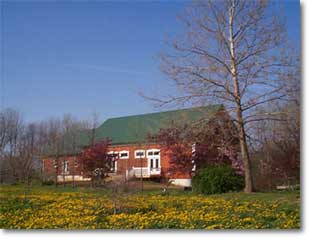
The 1880s Crow timber frame barn was originally used for storage of hay/feed and for providing shelter to livestock. The large structure was moved from the neighboring farm in 1997; renovations began in 1998. The first workshops taught at the barn were in 2001. |
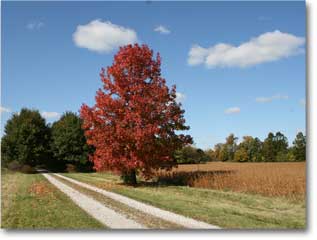
Tree-lined lane leads to the barn.The Crow Timber Frame Barn art retreats provide an opportunity to focus on one's art without the distractions of daily life. A nurturing, creative environment allows for personal growth and development. |
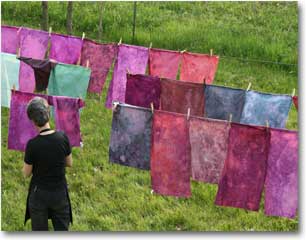
The dye studio at the Crow Timber Frame Barn includes large padded tables, lots of light (natural and color-corrected bulbs), 3 commercial stainless steel sinks, & washer/dryer. |
 |
 |
 |
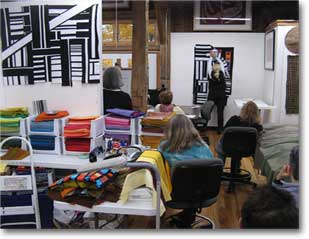
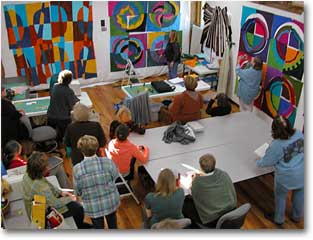
Contemporary quilt making, composition, color, design, machine-piecing, machine-quilting, strip-piecing, art quilt making classes are presented in superbly outfitted classrooms dedicated to serious art making. |
The professional facilities provide each student with a large work table, an 8’ x 8’ work wall, and a comfortable chair. Classrooms are well illuminated and are open from early morning until late in the evening. |
Surface design on fabric, fabric dyeing, fabric and paper collage, shibori, screenprinting, and mark-making are featured workshops offered at the Crow Timber Frame Barn art retreats. |
Nancy Crow | Home | Art Retreats | Craft Tours | Exhibitions | Workshops | Books | Gallery | Itinerary | Biography | Contact & Links
© 2002-2010 Nancy Crow, llc | Site designed by Nathaniel Stitzlein | Art Grange Studios
Notice: All images & materials on this site are protected by copyright law and may not be reproduced in whole or in part without the express written permission of Nancy Crow or the artist.
|
> Image gallery of the Crow Barn > Testimonials about the Crow Barn |